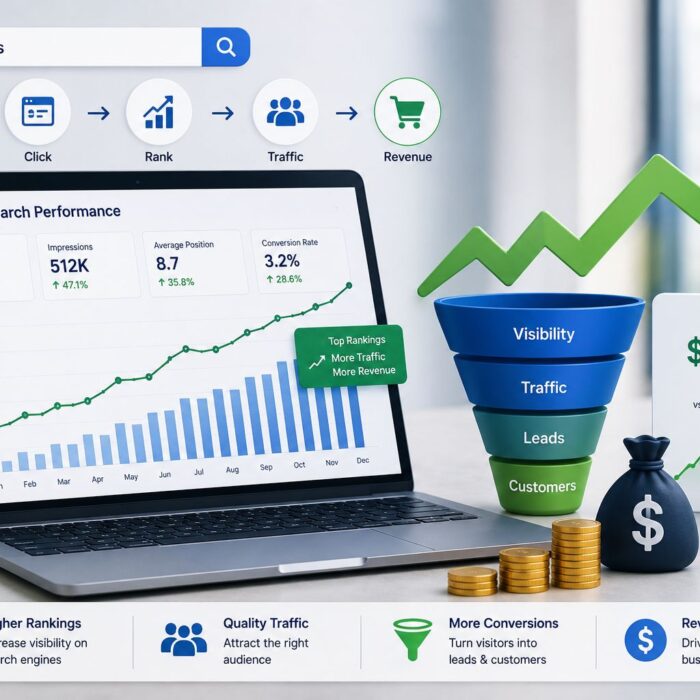

To increase organic search rankings, you need to combine technical SEO, quality content, authoritative backlinks, and a strong on-page strategy. Results typically take 3–6 months, but businesses that invest in a structured, ongoing approach consistently outperform competitors and generate sustainable organic revenue.
Your website is live. Your product or service is solid. But when potential customers search for what you offer, your site is nowhere to be found.
That gap between what your business delivers and where it appears in search results is a real problem and it costs revenue every single day. Companies that rank on the first page of Google capture the majority of organic clicks. Those sitting on page two or beyond are largely invisible.
The good news? Organic search rankings are not fixed. With the right strategy, any business can climb the search results and connect with high-intent customers who are actively looking for exactly what they offer.
This guide walks you through the core pillars of SEO that drive real ranking improvements. From technical fixes to content strategy, link building to AI search optimization—each section below adds something new and actionable to your approach. By the end, you will have a clear picture of what it takes to move the needle and sustain that growth over time.
Why Do Organic Search Rankings Matter for Your Business?
Before diving into tactics, it helps to understand why this matters so much from a business perspective.
Organic search traffic is different from paid traffic. It does not stop the moment your ad budget runs out. A well-optimized page can generate consistent traffic for months or years. That makes it one of the highest-ROI investments a business can make in its digital marketing.
Here is the practical reality. According to Google Search Central, the majority of searchers never scroll past the first page of results. Ranking position directly affects how many people click through to your site and how many of those visitors convert into customers.
Businesses that invest in professional SEO services early tend to build a compounding advantage. Rankings improve, domain authority grows, and the cost of acquiring each new customer through organic search continues to drop over time.
What Are the Core SEO Ranking Factors in 2026?
Google’s algorithm evaluates hundreds of signals when deciding where to place your page. But most experts agree on a core set of factors that carry the most weight.
Content quality and relevance: Google prioritizes pages that genuinely answer a searcher’s query. Thin, outdated, or low-effort content rarely ranks well, no matter how many other optimizations you apply.
Backlink authority: Links from reputable, relevant websites signal to Google that your content is trustworthy. Quality matters far more than quantity here.
Technical health: A slow, broken, or poorly structured website creates friction for both users and crawlers. Technical issues can suppress rankings even when everything else is done right.
User experience signals: Click-through rates, bounce rates, and time on page all influence how Google perceives the value of your content. A page that visitors quickly abandon sends a negative signal.
On-page optimization: Proper use of title tags, meta descriptions, headings, and keyword placement helps Google understand exactly what your page is about.
| Ranking Factor | Why It Matters | Common Mistake |
| Content Quality | Satisfies search intent and earns rankings | Publishing thin or copied content |
| Backlinks | Builds domain authority and trust | Focusing on quantity over quality |
| Technical SEO | Enables proper crawling and indexing | Ignoring site speed and mobile issues |
| On-Page SEO | Signals relevance to search engines | Keyword stuffing instead of natural use |
| User Experience | Affects engagement and retention signals | Cluttered layouts and slow load times |
How to Conduct an SEO Audit Before You Start
The most effective place to begin is with a comprehensive SEO audit. An audit gives you a clear picture of where your site currently stands and what is holding it back.
A thorough audit covers several areas:
- Crawlability: Can search engines access and index all your important pages?
- Site speed: Pages that load slowly lose rankings and visitors.
- Broken links and errors: 404 errors and redirect chains create a poor experience for both users and crawlers.
- Duplicate content: Multiple pages competing for the same keywords can confuse search engines and dilute rankings.
- Missing or weak metadata: Title tags and meta descriptions directly affect click-through rates from search results.
Once you identify the issues, you can prioritize fixes based on potential impact. Some technical corrections show results within weeks. Others form the foundation for long-term growth.
[IMAGE HERE – Screenshot of an SEO audit dashboard showing site health score, errors, and opportunities]
On-Page SEO: Optimizing Each Page for Maximum Visibility
On-page SEO is the process of optimizing individual pages so search engines can understand their relevance to specific queries. It is one of the most controllable aspects of SEO, and it directly impacts rankings.
How should you structure your title tags and meta descriptions?
Your title tag is typically the first thing a searcher sees in the results. Keep it under 60 characters, place your primary keyword near the beginning, and make it compelling enough to earn the click. Your meta description should expand on the title, include a relevant keyword naturally, and stay within 155 characters.
How do headings and internal linking affect rankings?
Headings (H1 through H6) help Google understand the structure and hierarchy of your content. Use your primary keyword in the H1 tag and incorporate related terms in H2 and H3 subheadings. Internal links connect related pages on your site, distribute authority across your domain, and help search engines discover new content. Both are often overlooked but consistently impactful.
Here is a quick on-page SEO checklist:
- Place the primary keyword in the H1, first paragraph, and at least one subheading
- Write unique, descriptive meta titles and descriptions for every page
- Use descriptive alt text for all images
- Include internal links to relevant service or resource pages
- Ensure your URL slug is short, clean, and keyword-relevant
- Format content with clear headings, bullets, and short paragraphs
Technical SEO: The Foundation That Most Businesses Ignore
Technical SEO refers to all the behind-the-scenes elements that affect how well search engines can crawl, index, and interpret your website. Poor technical health can quietly suppress rankings across your entire site.
The most impactful technical areas to address include:
Core Web Vitals: Google uses page experience signals—including loading speed, interactivity, and visual stability—as ranking factors. Scores are measured through tools like Google Search Console and Google Analytics.
Mobile optimization: The majority of searches now happen on mobile devices. A site that performs poorly on smaller screens will struggle to rank, regardless of content quality.
HTTPS and security: Google gives a slight ranking boost to secure sites. Any site still running on HTTP should migrate to HTTPS.
XML sitemap and robots.txt: A properly configured sitemap helps Google discover and index your pages efficiently. An incorrect robots.txt file can accidentally block important pages from being crawled.
Schema markup: Structured data helps search engines understand your content and can earn rich results like star ratings, FAQs, and event listings in the search results boosting both visibility and click-through rates.
Working with a team that provides technical SEO services ensures these issues are identified and resolved systematically rather than left to accumulate.
Content Strategy: How to Create Pages That Rank and Convert
Content remains the core of every successful SEO strategy. But not all content drives rankings. The difference between a page that ranks and one that does not usually comes down to how well it matches search intent.
What does it mean to match search intent for SEO?
Search intent refers to the underlying goal behind a query. Someone searching “best running shoes” is likely browsing options. Someone searching “buy Nike Air Max size 10” is ready to purchase. Your content needs to match that intent precisely.
There are four primary types of search intent:
- Informational: The user wants to learn something. Blog posts, guides, and FAQs work well here.
- Navigational: The user is looking for a specific website or brand.
- Commercial: The user is researching before making a decision. Comparison pages and case studies perform well.
- Transactional: The user is ready to act. Service pages and product pages should target these queries.
Creating content that serves each stage of the customer journey builds authority over time and captures traffic at every point in the decision-making process.
Practical content tips:
- Publish long-form, well-researched content on topics your audience is actively searching
- Update older posts with fresh information and new keywords
- Use FAQs, tables, and structured formats to improve readability and scannability
- Target a mix of high-volume and long-tail keywords to build rankings over time
- Avoid publishing multiple pages targeting the same keyword (keyword cannibalization)
Link Building: How to Earn Backlinks That Move Rankings
Backlinks remain one of the strongest ranking signals in Google’s algorithm. A link from a high-authority, relevant website acts as a vote of confidence in your content. Earning those links consistently is what separates stagnant sites from those that climb.
What link building strategies work best for organic ranking growth?
Effective link building is built on providing genuine value. Some of the most reliable methods include:
- Digital PR and outreach: Create data-driven studies, original research, or expert commentary that journalists and bloggers want to reference.
- Guest posting: Write high-quality articles for reputable websites in your industry with a contextual link back to your site.
- Broken link building: Find broken links on relevant sites and offer your content as a replacement.
- Local citations: For local businesses, consistent listings on directories like Google Business Profile, Yelp, and industry-specific platforms build both authority and local relevance.
- Content assets: Publish tools, calculators, infographics, or guides that others naturally want to link to.
What to avoid: link schemes, paid links, and low-quality directory submissions. Google’s algorithm is sophisticated enough to identify and discount manipulative link patterns, and manual penalties can be difficult to recover from.
Local SEO: How to Rank Higher for Searches in Your Area
If your business serves a specific geographic area, local SEO services represent one of the fastest paths to ranking improvement. Local search results appear prominently at the top of Google, often before organic listings, and they attract high-intent customers who are ready to act.
The key elements of a strong local SEO strategy include:
- Google Business Profile optimization: Keep your listing complete, accurate, and active with regular updates, photos, and customer reviews.
- Consistent NAP data: Your Name, Address, and Phone Number should be identical across every directory and platform where your business appears.
- Localized content: Service pages and blog posts that reference specific neighborhoods, cities, or regions send strong local relevance signals.
- Review generation: A steady stream of positive reviews improves both your local rankings and your conversion rate from map listings.
- Local backlinks: Links from local news sites, business associations, and community organizations strengthen your local authority.
Businesses in competitive markets like Toronto, Montreal, or Miami often benefit most from working with a specialized team that understands the nuances of local search in those regions.
AI SEO: Ranking in an Era of Generative Search
Search is evolving. Google’s AI Overviews, voice search, and conversational AI tools like ChatGPT are changing how people find information and how businesses need to optimize their content.
Ranking in traditional search results is still critical. But increasingly, businesses also need to appear within AI-generated summaries and featured snippets that sit above the organic results.
Managed SEO services that incorporate AI SEO strategies focus on:
- Structured, answer-first content: Pages that directly and clearly answer questions are more likely to be cited by AI models.
- Conversational keyword targeting: Users ask AI tools full questions rather than typing fragmented search queries. Optimizing for natural language patterns captures this traffic.
- People Also Ask (PAA) optimization: Appearing in PAA boxes increases visibility and brand recognition even when users do not click through.
- Voice search readiness: Content formatted for spoken queries tends to be concise, question-and-answer based, and highly specific.
Businesses that adapt their SEO strategy now to account for these shifts are positioning themselves ahead of competitors who are still catching up.
Common SEO Mistakes That Kill Rankings
Even well-intentioned SEO efforts can backfire if certain mistakes go unchecked. Here are the ones that cause the most damage:
- Keyword stuffing: Forcing keywords into content unnaturally hurts readability and can trigger Google penalties.
- Ignoring technical issues: A single crawl error or slow-loading page can suppress rankings across your entire domain.
- Publishing thin content: Pages with little substance and no clear value signal low quality to search engines.
- Neglecting mobile users: A poor mobile experience directly affects both rankings and conversion rates.
- Buying low-quality backlinks: Manipulative link schemes can result in manual penalties that are difficult and time-consuming to reverse.
- Treating SEO as a one-time project: Search algorithms change constantly. A strategy that worked six months ago may need adjustment today.
How Long Does It Take to Increase Organic Search Rankings?
This is the most common question businesses ask and the honest answer is: it depends.
Some technical fixes, like correcting crawl errors or improving page speed, can show measurable impact within weeks. But meaningful improvements in keyword rankings and organic traffic typically take 3–6 months for most websites.
Competitive industries take longer. New websites with little domain authority take longer. Sites with significant technical debt take longer. But with a consistent, well-structured approach, organic growth compounds over time in ways that paid advertising cannot replicate.
The key is patience combined with persistence. Businesses that commit to a long-term SEO strategy consistently outperform those that expect overnight results.
Take the Next Step Toward Higher Rankings
Increasing your organic search rankings is not a one-time task. It is a combination of technical precision, content quality, authoritative links, and ongoing optimization executed consistently over time.
The businesses that rank at the top of Google are not there by accident. They have built a foundation that search engines trust, and they continue to invest in maintaining and growing that foundation.
If your website is not generating the traffic and leads it should be, the right strategy makes all the difference. Perron Marketing Group has helped businesses across Toronto, Montreal, Miami, and beyond achieve measurable organic growth including a 150% increase in SEO traffic and a 2.6x increase in organic revenue.
Get your free SEO proposal and find out exactly what it will take to move your website to the top of the results.
Frequently Asked Questions
How long does it take to see results from organic SEO?
Most websites begin to see meaningful improvements in traffic and keyword rankings within 3–6 months of implementing a structured SEO strategy. Timelines vary depending on industry competition, domain age, and the current state of your website’s technical health. Highly competitive markets may require 9–12 months before significant gains appear in search rankings.
What is the difference between on-page SEO and off-page SEO?
On-page SEO refers to optimizations made directly on your website—title tags, headings, content, internal links, and page speed. Off-page SEO involves actions taken outside your site, primarily earning backlinks from other reputable websites. Both are essential. On-page SEO establishes relevance, while off-page SEO builds the authority that helps Google trust and rank your content.
Can a small website compete with large, established brands in search results?
Yes. Targeting high-intent, long-tail keywords is one of the most effective ways smaller websites can compete. Larger brands often neglect specific, niche queries because they focus on high-volume terms. By building authority around these targeted keywords first, smaller businesses can earn consistent traffic and gradually build the domain strength needed to compete on broader terms.
What is technical SEO, and why does it matter for rankings?
Technical SEO refers to the behind-the-scenes elements that affect how search engines crawl, index, and interpret your website. This includes site speed, mobile responsiveness, URL structure, schema markup, and crawlability. Poor technical health can suppress rankings even when your content and backlinks are strong. Fixing technical issues often produces some of the fastest measurable improvements in organic performance.
What is AI SEO, and does my business need it?
AI SEO is the practice of optimizing your content and website to appear in AI-generated search experiences including Google’s AI Overviews, voice search results, and conversational AI tools. It involves structured, answer-first content, natural language keyword targeting, and PAA optimization. If your audience uses voice search or relies on AI assistants for recommendations, AI SEO is increasingly important for maintaining and growing your organic visibility.
Is SEO a one-time investment or an ongoing effort?
SEO requires ongoing effort to maintain and grow results. Search algorithms update regularly, competitors continue optimizing, and user behavior shifts over time. A one-time SEO project may produce short-term gains, but without continuous optimization, rankings tend to decline. Businesses that invest in managed SEO services on an ongoing basis consistently outperform those that treat it as a single project.