
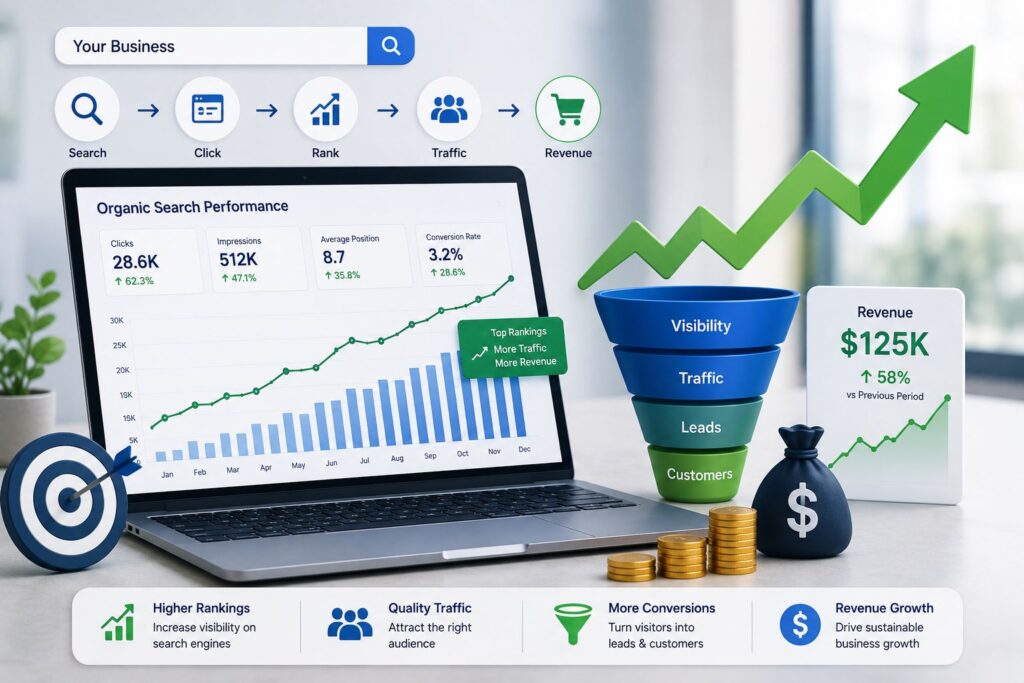
Custom SEO solutions grow organic revenue by targeting the exact keywords your buyers search for, fixing technical issues that block rankings, and building content that earns qualified traffic. Unlike generic packages, a custom strategy focuses on revenue, not just rankings, so every improvement ties back to real sales.
Most business owners feel the same frustration. You built something valuable, yet your website sits on page three while competitors grab the customers who should be yours.
The problem is rarely your product. It is usually your strategy.
Generic SEO packages treat every business the same. They chase traffic that never converts. They report on vanity metrics that look nice but never touch your bottom line.
A custom approach works differently. It starts with your goals, your market, and your buyers. Then it builds a plan around driving revenue, not just clicks.
In this guide, you will learn what custom SEO actually includes, how it grows organic revenue, the common mistakes to avoid, and how to choose an SEO company you can trust. Business owners should care because organic search is often the single most cost-effective way to grow long term.
What Are Custom SEO Solutions?
Custom SEO solutions are strategies built around your specific business instead of a one-size-fits-all template. They match your industry, your competition, and your revenue goals.
Think of it this way. A local dental clinic and a national e-commerce store need very different plans. One needs to win nearby searches. The other needs to scale content across thousands of product pages.
A good SEO agency studies your situation first. Then it builds a roadmap that fits.
Here is what a custom plan usually covers:
- A full audit of your current website health
- Keyword research based on buyer intent
- On-page and technical improvements
- Content built to answer real questions
- Link building to grow your authority
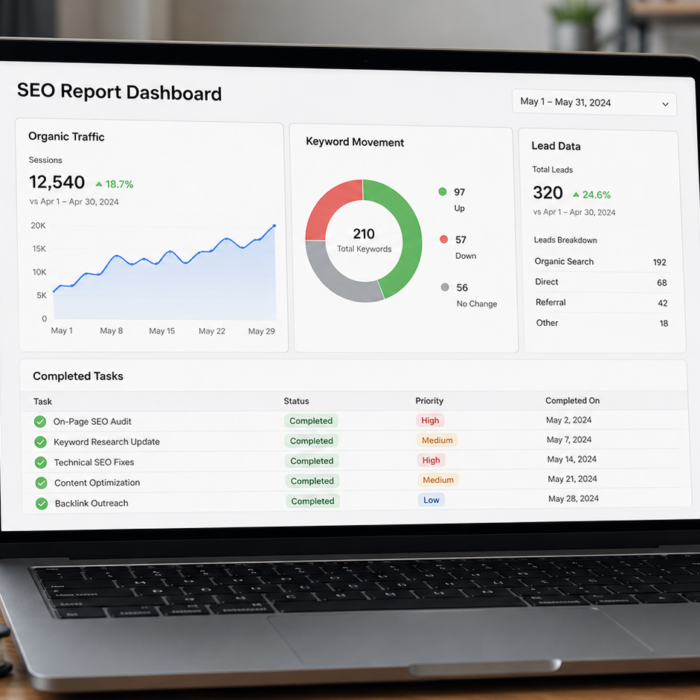
- Clear reporting tied to your goals
At Perron Marketing Group, this starts with a deep audit that uncovers hidden issues and quick wins. You can explore the full process on our SEO services page.
Why Custom SEO Matters for Organic Revenue
Organic revenue is money you earn from unpaid search traffic. It compounds over time, which makes it one of the smartest long-term investments you can make.
Paid ads stop the moment you stop paying. SEO keeps working. Once you rank for the right terms, you attract buyers day and night without paying for every click.
The key word is right. Ranking for terms nobody searches, or terms that never convert, wastes budget and time.
Custom SEO fixes this by focusing on high-intent keywords. These are the phrases people type when they are ready to buy or book.
Why It Matters
- Traffic without intent rarely turns into sales
- Custom targeting attracts buyers, not just browsers
- Revenue-focused strategy proves your ROI
- Long-term rankings reduce your ad spend
What Does an SEO Audit Reveal?
An SEO audit is the starting point for growth. It shows what is holding your site back and where the fastest wins live.
Many websites have hidden problems the owner never sees. Slow load times. Broken links. Pages that search engines cannot crawl. These quietly drain your rankings.
A strong audit checks three main areas.
Technical health: site speed, mobile usability, crawl issues, and indexing.
On-page factors: titles, headings, content quality, and keyword use.
Off-page signals: backlinks, brand mentions, and authority.
Google explains many of these basics in its own Search Central documentation, which is a helpful resource for understanding how search works.
Once the audit is done, you get a clear list of priorities. If you want a professional review of your own site, our SEO audit service is a smart place to begin.
[IMAGE 2 HERE – A technical SEO audit checklist highlighting site speed, mobile, and crawl issues]
The Three Pillars of a Revenue-Driven SEO Strategy
A results-based SEO strategy stands on three pillars. Each one supports the others. Skip one, and growth slows down.
1. Technical SEO
Technical SEO makes your site easy for search engines to read. It covers speed, mobile friendliness, site structure, and clean code.
If Google struggles to crawl your pages, your content will not rank no matter how good it is. Strong technical SEO removes those roadblocks.
2. On-Page and Content SEO
This pillar focuses on the words on your pages. It means writing helpful content that answers what people search for.
Google rewards content that genuinely helps users. Its Helpful Content guidance makes this clear. Write for people first, and rankings tend to follow.
3. Off-Page SEO and Authority
Off-page SEO builds trust. It happens through backlinks, reviews, and mentions from other trusted websites.
Think of each quality backlink as a vote of confidence. The more votes you earn from respected sites, the more authority you gain.
Comparison: SEO vs Paid Ads
Many owners ask whether they should invest in SEO or paid ads. Both have a place. The right choice depends on your goals.
| Factor | SEO | Paid Ads (PPC) |
| Speed of results | Slower, builds over months | Instant visibility |
| Cost over time | Drops as rankings grow | Constant spend required |
| Traffic after you stop | Continues to flow | Stops immediately |
| Trust with users | High, organic listings | Lower, marked as ads |
| Best for | Long-term growth | Quick campaigns or launches |
Choose SEO if long-term, sustainable revenue matters more than instant traffic. Choose paid ads if you need fast results for a launch or a short promotion. Many businesses run both together for the best of both worlds.
Common SEO Mistakes That Hurt Revenue
Even well-meaning businesses make costly mistakes. Knowing them helps you avoid wasted effort.
- Chasing traffic, not sales. High traffic feels great, but it means little if visitors never convert.
- Ignoring technical issues. A slow or broken site drives users away and blocks rankings.
- Keyword stuffing. Overloading pages with keywords hurts readability and rankings.
- Buying cheap backlinks. Low-quality links can trigger penalties and damage trust.
- No clear tracking. Without conversion tracking, you cannot prove what works.
- Setting and forgetting. Search changes constantly, so SEO needs ongoing care.
Step-by-Step: How Custom SEO Grows Your Revenue
Here is how a strong campaign moves from setup to sales.
- Audit your site. Find technical issues and quick wins.
- Research keywords. Focus on terms your buyers actually use.
- Fix the foundation. Improve speed, structure, and mobile experience.
- Optimize your pages. Update titles, headings, and content for intent.
- Create helpful content. Answer the questions your audience asks.
- Build authority. Earn quality backlinks over time.
- Track and refine. Measure results and adjust the plan.
This cycle repeats and improves with each round. That is why ongoing managed SEO services tend to outperform one-time projects.
How AI Is Changing SEO
Search is shifting fast. AI now powers many search results, including AI overviews and voice answers.
This means your content needs to do more than rank in blue links. It should be clear enough for AI tools to quote and summarize.
Practical steps include writing direct answers, using clean structure, and answering real questions. Optimizing for voice search and “People Also Ask” sections also helps.
If you want to future-proof your visibility, our AI SEO services are built for exactly this shift.
Expert Tips for Better SEO Results
A few smart habits make a big difference over time.
- Focus on buyer intent, not just search volume.
- Update older content to keep it fresh and accurate.
- Track calls and form fills, not just page views.
- Prioritize mobile users, since most searches happen on phones.
- Be patient, since meaningful rankings often take three to six months.
How to Choose the Right SEO Company
Not every provider is the same. The right partner focuses on your revenue, not empty promises.
Ask these questions before you sign anything:
- Do they offer a custom strategy or a fixed package?
- Can they show real case studies and results?
- Do they explain their work in plain language?
- Do they lock you into long contracts?
- How do they measure success?
Choose transparency over hype. A trustworthy agency reports on traffic, leads, and conversions, not vanity numbers. You can review real outcomes on our case studies page.
Your SEO Checklist Before You Start
Use this quick checklist to prepare for a strong campaign.
- Set clear revenue and lead goals
- Run a full site audit
- Confirm conversion tracking is in place
- Research high-intent keywords
- Plan helpful, original content
- Choose a transparent SEO partner
Frequently Asked Questions
How much do custom SEO services cost?
Pricing varies based on your market, competition, and goals. A small local business will pay less than a large national brand with thousands of pages. The best approach is a custom quote tied to your specific needs. Focus less on the lowest price and more on the return. Good SEO should pay for itself through new leads and sales over time.
How long before I see real revenue from SEO?
Most businesses see meaningful traffic growth within three to six months. Some technical fixes bring quicker wins. Revenue tends to build steadily after rankings improve. Highly competitive industries may take longer. The key is consistency, since SEO compounds. The longer you invest, the stronger and more stable your results usually become.
Can a small business outrank big brands?
Yes. Smaller businesses often win by targeting specific, high-intent keywords that large brands overlook. Local searches and niche terms offer real openings. By focusing on gaps in the market, a small site can rank fast and grow authority over time. Big budgets help, but smart strategy often beats sheer size.
Is SEO a one-time project or ongoing work?
SEO is ongoing. Search engines update often, and competitors keep improving. A one-time push may bring short gains, but rankings fade without maintenance. Ongoing work keeps your site healthy, your content fresh, and your rankings stable. Think of it like fitness. Consistent effort delivers lasting results, while stopping causes you to slip.
What is the difference between SEO and local SEO?
Standard SEO aims to rank your site broadly, often nationally or globally. Local SEO focuses on customers in a specific area. It optimizes your Google Business Profile, local citations, and “near me” searches. If you serve a defined region, local SEO services help you capture nearby buyers ready to act.
How do you measure SEO success?
Success is measured by outcomes that matter to your business. That means organic traffic growth, keyword rankings, and most of all, leads and conversions. Vanity metrics look nice but prove little. A good report ties results directly to revenue, so you always know exactly what your investment is earning.
Turn Search Into Steady Revenue
Custom SEO is not about chasing rankings for their own sake. It is about connecting your business with the right people at the right moment, then turning that visibility into real revenue.
The path is clear. Audit your site, fix the foundation, target buyer intent, and stay consistent. Do that well, and organic search becomes one of your most reliable growth engines.
You do not have to figure it out alone. Perron Marketing Group builds custom, revenue-focused strategies that take the guesswork out of search. Reach out today and let us start building a plan designed around your goals.